Why Choose BUILD: A Letter from Larry on What We Actually Do Here
By Larry Meyer, PT, DPT — Owner, BUILD Sports Performance Lab & PT
There's a moment that happens in our clinic almost every week. Someone walks in for the first time — usually a runner or a cyclist, sometimes a parent of a high-school athlete, sometimes a grandparent who just wants to get back to hiking with their kids and within the first ten minutes they exhale, settle into the chair, and say some version of the same thing:
“This is the first time someone has actually sat down and listened.”
That moment is the reason BUILD exists. Not because we think we're better than anyone else doing this work. There are wonderful clinicians and fitters all over this country, and we have deep respect for the craft. We're not trying to compare to other clinics. We're trying to be who we are, because comparisons kill joy. And the joy of doing this work fully present, with the person in front of you is the whole point.
I want to use this space to tell you, honestly, why we built BUILD the way we built it, what you can expect when you walk through our doors in Louisville, Colorado and how we think about the work of helping a human body move better. This isn't a sales pitch. It's an invitation to come see for yourself whether the way we practice resonates with what you've been looking for.
We Started with a Simple Question: How Do You Actually Feel?
Most healthcare visits begin with paperwork. Ours begin with a conversation.
When someone is dealing with an injury like a nagging knee, a hip that won't quiet down, a shoulder that's been clicking for two years- the physical part is only half the story. The other half is the emotional weight that comes with it. The frustration of not being able to ride the way you used to. The fear that something is permanently wrong. The quiet grief of watching your training partners go on without you. The doubt that creeps in when you've already tried two or three things and nothing has worked.
That part matters to us. Not as a bedside-manner technique, but because it shapes everything we do next. How you feel about your injury is information. It tells us what you've been worried about, what you've already tried, what you're afraid we're going to say. And it tells us how to meet you where you are, not where a textbook says you should be.
Think of it like this: if you walked into a mechanic's shop with a strange noise in your engine, you'd want a mechanic who actually drove the car around the block with you, listened to the sound, asked when it started, and then opened the hood. You wouldn't want someone who glanced at it from across the bay and handed you a part. The body is infinitely more complex than a car, and the stakes are higher. You deserve someone who actually drives around the block with you.
The Science Is Strong. The Reasoning Is Stronger.
BUILD is, at its heart, a biomechanics and performance optimization clinic. That's a mouthful, so let me unpack what it really means.
Biomechanics is the study of how forces move through a human body. Every step you take, every pedal stroke, every overhead reach is a chain of joints and muscles negotiating gravity, momentum, and load. When that chain works well, you move efficiently and pain-free. When one link of the chain is compensating, maybe your hip isn't extending fully, maybe your foot is collapsing a quarter-second too early, the rest of the chain pays the price. Often the place that hurts is not the place that's broken. The knee that screams is frequently the messenger for a hip that went quiet.
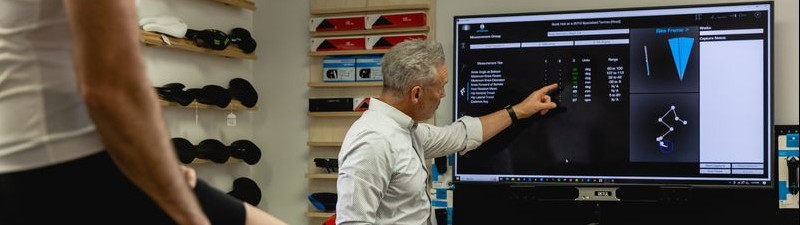
This is where the science comes in. We use 3D motion-capture analysis for bike fitting, high-speed video for running gait, force-plate data, segmental body composition, strength and balance testing. This is the kind of objective measurement that takes guesswork out of the equation. When we tell you something about your glutes, your ankle mobility, your stride mechanics, we can show you. Data turns opinion into evidence, and evidence is what lets us build a plan you can actually trust.
But here's the thing: data is only as good as the reasoning around it. A bike fit isn't a number on a spreadsheet. A gait analysis isn't a graph. They're stories about how a particular human body, with its particular history and particular goals, is solving the problem of movement. And reading those stories well takes critical thinking, pattern recognition, and a willingness to keep asking “but why?” until you actually find the root cause.
Our team is genuinely good at this part. Evan Culbert, our Director of Operations and a Doctor of Physical Therapy, has a sharp clinical eye and the kind of patience that lets him chase a problem three layers deep instead of accepting the surface answer. Paige Dow, also a DPT, brings a calm, methodical thoroughness to every evaluation that you can feel from the moment you meet her. And I bring more than two decades of work in bike fitting, gait analysis, and rehab biomechanics and a deep love for the puzzle of it. When you put our team in a room together with a difficult case, the reasoning gets sharp. Cases get talked through. Hypotheses get tested. Nobody is too proud to ask a colleague for a second set of eyes.
And that's really what you're paying for, when you come to BUILD. Not just the equipment. Not just the credentials. The reasoning.
Troubleshooting Is a Craft
I want to spend a minute on this because I think it's the most undervalued skill in our entire profession.
When someone has had pain for six months, or two years, or longer, the easy explanations are usually gone. They've already tried rest. They've already tried stretching. They've already had an X-ray that came back “unremarkable.” They're sitting in front of us because the obvious moves didn't work.
That's when troubleshooting becomes a craft. It looks a lot like what a good detective does: gathering evidence, building hypotheses, testing them, discarding the ones that don't hold up, and following the trail to wherever it actually leads, not where you assumed it would lead. We're trained to do this, and frankly, we love doing it. There's nothing more satisfying than sitting with a complicated case and slowly, carefully, finding the thread that ties it all together.
If you've been the patient nobody could quite figure out, you're exactly the person we want to meet.
Three Doors, One Philosophy
People sometimes get confused about what exactly we do, because BUILD has three main service lines, and from the outside they can look like three different businesses. They're not. They're three doors into the same philosophy.
- Physical Therapy is for when something hurts, or when you're recovering from a surgery, or when a body part isn't doing its job. We treat the full range — runners and riders, weekend hikers, lifters, post-op patients, kids, grandparents. Every session is a focused 60 minutes, one-on-one with a Doctor of Physical Therapy, start to finish. That's how we believe this work is best done.
- Bike Fitting is for cyclists who want their bike to fit them, not the other way around. A great bike fit is the difference between a ride that wears you down and a ride that lifts you up. We use motion capture, pressure mapping, and the kind of fine-grained adjustments that only experience can guide. Whether you're trying to ride your first century or chase a podium, the fit is the foundation everything else is built on.
- Running Gait Analysis is for runners who want to understand what's actually happening when their foot meets the ground. We use high-speed video and biomechanical assessment to map out your running form, identify the patterns that put you at risk, and build a plan to make you more efficient and more durable. It's one of the most useful 90 minutes a runner can spend.
All three of these doors lead to the same place: a careful, evidence-informed, thoughtful approach to helping you move better and feel better. The doors are different because people come to us at different stages, some hurt, some healthy and trying to optimize performance, but the philosophy is consistent.
The Experience Matters from the Moment You Walk In
I want to talk about something that might sound small but isn't: how it feels to be in our space.
From the moment you walk through our front door, we've thought hard about what your experience should feel like. The space is clean and bright. There's natural light. The equipment is well-maintained. One of our front desk staff will greet you by name, because they've already pulled up your appointment and read through what you're coming in for. You'll feel welcomed, like the visit started before you even sat down.
This isn't decoration. It's part of the care. When a place feels considered, when the people who work there clearly enjoy being there, when the details add up,that environment lowers your nervous system. It tells your body it's safe to slow down, to be honest about what hurts, to ask the questions you've been holding back. Healing happens better in a place that feels good to be in. We take that seriously.
And once you're in a treatment room with one of our therapists or fitters, that same care continues. You'll be listened to without being interrupted. You'll be examined carefully. And when we explain what we found, we'll explain it in language you actually understand.
Explanations That Actually Make Sense
This one is close to my heart. One of the things we hold ourselves to most strictly is this: we will not hide behind jargon. “You have patellofemoral pain syndrome with associated VMO inhibition and a positive Clarke's sign.” Okay. What does that mean? What do I do tomorrow morning? If we can't answer those questions in plain language, we haven't actually finished the work.
We are committed to explaining injuries and findings in plain English. We use analogies. We draw pictures. We show you the video of your own body moving and walk you through what we're seeing. We connect the dots between the pain you're feeling and the mechanics that are producing it. And then we tell you, specifically, what we're going to do about it and what your role in that plan is.
Because here's the truth: you are the expert on your body. You live in it twenty-four hours a day. We're the experts on movement and tissue and rehab and biomechanics. The best outcomes happen when those two kinds of expertise are pooled together. That requires us to teach, not to lecture. To translate, not to obscure. To respect that you came here to learn what's going on, not to be talked down to.
If you leave a session with us not understanding what we found and what the plan is, we have failed you. That's the standard.
Built on Community, Not Volume
BUILD has grown the way it has (quietly, steadily, and mostly through word of mouth!) because we've never been interested in volume. We're interested in people.
When you're treated by us, we want to know about your life. The race you're training for. The kid you can't keep up with. The job that's been beating up your shoulders. The trip to Iceland you've been planning for two years. Those details aren't small talk; they're the context that makes a treatment plan actually fit your life. A protocol designed for a marathon runner two months out from her first 26.2 looks different from a protocol designed for a busy parent who has thirty minutes a day, three days a week. Both are valid. Both deserve a plan that respects their reality.
This is also why we lean so heavily on our community. The people who come to BUILD often refer their friends, their training partners, their families. We do have a referral program. It's not fancy, but it's our way of saying thank you when someone you love walks through our door because of you. Mostly, though, those referrals happen because people had a good experience and wanted someone they care about to have the same. That is, hands down, the best compliment our team can receive and the deepest responsibility we carry. When someone trusts us with someone they love, we feel it.
We also work closely with the local cycling clubs, running groups, coaches, and physicians. We host courses through Evidence in Motion. We support our local races and events. The clinic isn't a fortress; it's a node in a network. The healthier that network is, the better everyone in it gets to feel.
Who BUILD Is For
Honestly? Anyone with a body that wants to move better.
We see professional athletes and we see retirees who just want to walk their dog without their hip flaring up. We see twelve-year-olds with growing-pain knees and seventy-year-olds who refuse to give up their tennis game. We see post-op patients in the slow, patient grind of getting their lives back, and we see elite cyclists shaving watts off their threshold. We see weekend warriors who finally got tired of being injured every spring and decided to get to the bottom of it.
If you have a body and you'd like that body to do more of what you love and less of what you don't, you're our person. There's no minimum fitness level. You don't have to be “athletic” in the way that word usually gets used. You just have to be willing to show up and be a participant in your own care.
What Happens Next
If anything in this article has resonated with you- if you've been carrying around an injury that nobody has been able to fix, if you've been curious whether a bike fit could really change your riding, if you've wondered why you keep getting hurt every time you ramp up your running, if you simply want to move better and feel better as you get older- I want to invite you in.
The first step is easy. Text or call us at 720-710-8136. Tell us what's going on. We'll help you figure out which of our services makes the most sense as a starting point: sometimes that's PT, sometimes it's a fit, sometimes it's a gait analysis, and sometimes a quick conversation is enough to point you in the right direction. We also have free 10-minute telehealth sessions you can schedule here. There's no pressure, and no commitment beyond the visit itself.
And then come see us. Walk through the door. Let us greet you, listen to you, examine you carefully, and explain what we find. If we're the right fit, we'll build a plan together. If we're not, we'll tell you that honestly and help you figure out where to go next. Either way, you'll leave knowing more than you came in with.
A Final Word
I started BUILD because I believed (and still believe) in a particular kind of care. Care that listens. Care that thinks. Care that explains. Care that treats the human being in front of it as a whole person, not a body part with a billing code. That's the standard we hold ourselves to, every day, and it's what BUILD is about.
We don't always get it perfect. Nobody does. But we work at it, every single day, with a team I genuinely love working alongside, in a community I'm proud to serve. If we can be part of your story — if we can help you ride longer, run further, lift heavier, sleep better, play with your kids without wincing, get back to the trail you've missed — that's the entire reason we're here.
Thank you for reading. Whatever you're carrying right now, I hope you find your way through it. And if we can help, we'd be honored to.
With care,
Larry Meyer, PT, DPT
Owner, BUILD Sports Performance Lab & PT
165 McCaslin Blvd, Suite B • Louisville, CO 80027 • buildyou.co